
Multi-hazard and Early Warning in Volcanology
The “Multi-hazard and Early Warning in Volcanology” Working Group of IAVCEI was established following the “Advancing Volcanic Hazards in EW4All” workshop held in Geneva from 7–9 July 2025, in association with the 2025 IAVCEI Scientific Assembly. This initiative contributes to the global Early Warning for All (EW4All) framework, launched by António Guterres, UN Secretary General, in 2022, which aims to ensure that all communities at risk are protected by effective early warning systems.
Scope and Strategic Role
A central objective of the Working Group is to support the integration of volcanic risk within global early warning initiatives, building on and extending the EW4All approach. By positioning volcanology within this and other international frameworks, the group seeks to ensure that volcanic risk are fully embedded in multi-hazard early warning systems and global disaster risk reduction strategies.
The Working Group brings together researchers, volcano observatories, operational agencies, UN bodies, and practitioners to strengthen volcanic early warning systems through a coordinated, interdisciplinary approach aligned with the four EW4All pillars:
- Disaster risk knowledge and management
- Detection, monitoring, analysis, and forecasting
- Warning dissemination and communication
- Preparedness and response capabilities
The group also promotes collaboration with key international partners, including United Nations Office for Disaster Risk Reduction (UNDRR), World Meteorological Organization (WMO), International Telecommunication Union (ITU), International Federation of Red Cross and Red Crescent Societies (IFRC), and United Nations Educational, Scientific and Cultural Organization (UNESCO), ensuring alignment with global efforts and fostering cross-sectoral exchange of expertise.
While maintaining a strong focus on early warning systems, the Working Group also aims to contribute, where relevant, to broader policy processes related to volcanic and multi-hazard risk. In particular, it can help identify emerging policy opportunities and coordinate input from the volcanological community to ensure that scientific knowledge is effectively reflected in regional and global risk governance frameworks.
Motivation
Volcanic hazards have significant impacts on populations, livelihoods, critical infrastructure, and the environment across local, regional and global scales. Their complex interactions with other hazards, including cascading effects, remain insufficiently understood, underscoring the need for strengthened interdisciplinary and cross-sector collaboration.
Advancing volcanic hazard early warning systems therefore requires not only scientific progress, but also its effective translation and integration, of that science, into people-centred warning systems and preparedness measures. Strengthening communication, operational services, and community engagement is essential to provide timely and actionable information, reduce risk, and build resilience.
The Working Group promotes the integration of scientific expertise from IAVCEI and volcano observatories into operational frameworks, with a focus on:
- Improve the quality and usability of monitoring and forecasting information,
- Identify actionable pathways to strengthen early warning systems,
- Clarify roles and responsibilities across the early warning chain,
- Support community-centred preparedness and response, and
- Enhance the combined availability, consistency, simplicity and effectiveness of warnings for all natural hazards.
This work directly contributes to the implementation of the Sendai Framework for Disaster Risk Reduction and reinforces the objectives of EW4All.
Case Study Series
A key activity of the Working Group is the development of a series of case studies, published through the IAVCEI website, quarterly newsletters and social media. These case studies:
- Highlight practical examples of volcanic early warning systems,
- Demonstrate integration across EW4All pillars,
- Share lessons learned, challenges, and successes, and
- Promote exchange of best practices across communities.
The series was launched with the initial contributions:
- Hazards information and models inspire community-wide mitigation & preparation near Mount Rainier, USA, December 2025.

- The UWI Seismic Research Centre’s response to the 2020–2021 La Soufrière eruption, St. Vincent, April 2026.
- A new operational multi-hazard approach for communicating volcanic hazards in Iceland
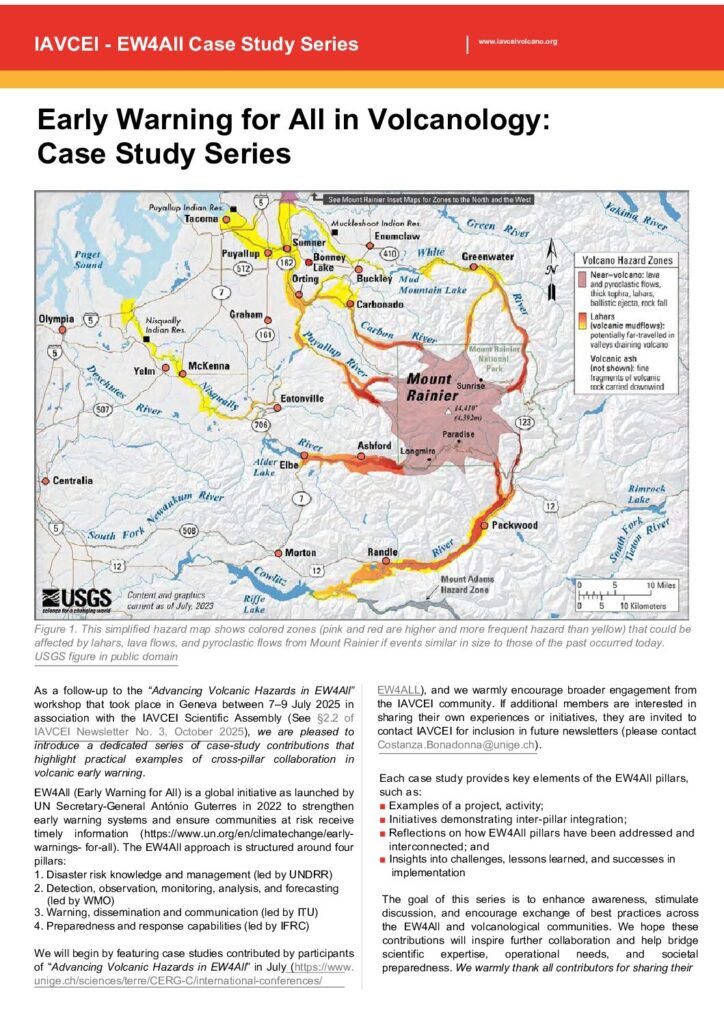
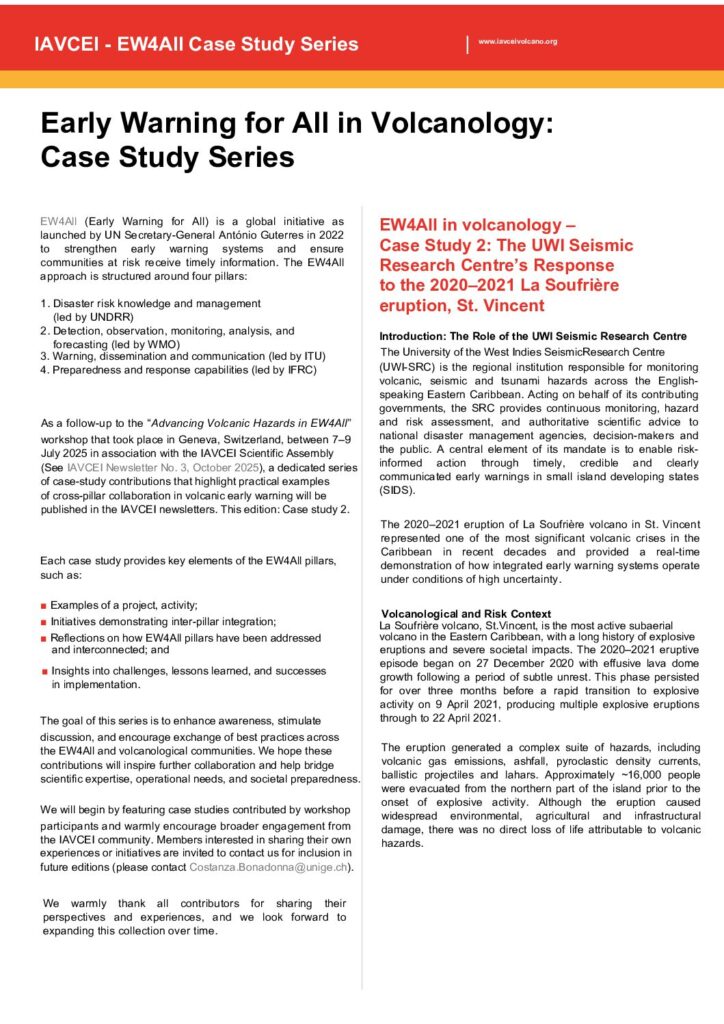

The Working Group strongly encourages further contributions to expand this collection and showcase diverse global experiences. Interested contributors are invited to get in touch.
Community Engagement
The Working Group provides an open platform for collaboration across the volcanological and disaster risk reduction communities. It actively encourages contributions from scientists, observatories, operational agencies, and stakeholders working at the science–policy–practice interface.
In this context, the Working Group can also serve as a coordination point for engaging with relevant international and regional policy developments, helping to channel collective expertise from the community in a timely and strategic manner.
By bridging scientific expertise, operational implementation, and societal needs, the Working Group aims to advance inclusive, actionable, and globally integrated early warning systems for volcanic hazards.
Working Group Composition
The Working Group brings together experts from academia, volcano observatories, operational agencies, and international organizations:
Chair
Costanza BONADONNA, University of Geneva, Switzerland
Members
- Charles BALAGIZI, Goma Volcano Observatory, Congo (DRC)
- Sara BARSOTTI, Icelandic Meteorological Office, Iceland
- Mariton BORNAS, PHIVOLCS, Philippines
- Marta CALVACHE, Colombia Geological Survey, Colombia
- Nico FOURNIER, Earth Science, New Zealand
- Eisuke FUJITA, National Research Institute for Earth Science & Disaster Resilience, Japan
- Sebastian GARCIA, SEGEMAR, Argentina
- Matthew HORT, UK Met Office, UK
- Erouscilla (Pat) JOSEPH, UWI Seismic Research Centre, Trinidad & Tobago
- Ulrich KUEPPERS, Ludwig-Maximilians-Universität (LMU) Munich, Germany
- Graham LEONARD, Earth Science, New Zealand
- Jake LOWENSTERN, USGS, USA
- Lara MANI, Global Volcano Risk Alliance
- Gari MAYBERRY, USGS, USA
- Jacqueline RIVERA, Ministry of Environment and Natural Resources, El Salvador
- Richard ROBERTSON, UWI Seismic Research Centre, Trinidad & Tobago
- Laura SANDRI, INGV
- Jonathan STONE, International Federation of Red Cross and Red Crescent Societies (IFRC)
- Benoit TAISNE, Earth Observatory of Singapore, NTU, Singapore
- Andrew TUPPER, World Meteorological Organization (WMO)
- Muhibuddin USAMAH, World Meteorological Organization (WMO)
- Christina WIDIWIJAYANTI, Earth Observatory of Singapore, NTU, Singapore
Get Involved
Members of the community interested in contributing case studies or participating in Working Group activities are invited to get in touch with the IAVCEI Secretary General. The Working Group will actively engage with existing IAVCEI Commissions (e.g. Volcanic Hazard and Risk, Tephra Hazard Modelling) and Networks (e.g., World Organisation of Volcano Observatories – WOVO) to ensure complementarity, coordination, and maximum impact.